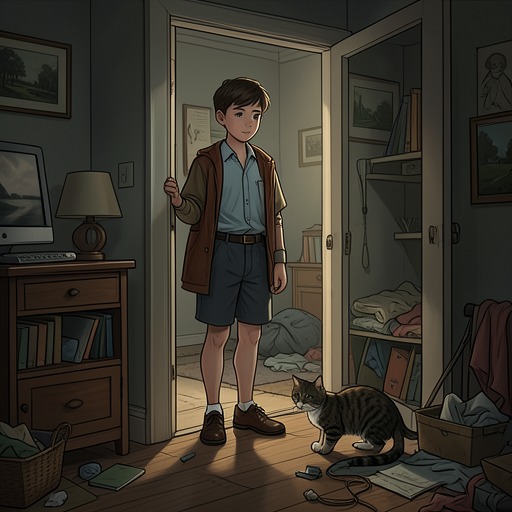
Geraldine drives Pecola out of the house
The Bluest EyeGeraldine drives Pecola out of the house in a scene where accusation becomes expulsion. After Junior claims that Pecola killed the cat, Geraldine tells her to leave; Pecola backs toward the front door and goes out into the cold. The episode makes a child’s exclusion literal while exposing the racialized standards of belonging that Geraldine has made part of her household.
The accusation and expulsion
Geraldine opens the door and asks what has happened. Junior points to the cat and blames Pecola for its death. His accusation becomes the immediate cause of Geraldine’s decision: rather than protect or question Pecola, she tells the girl to get out. The movement from Junior’s charge to Geraldine’s command is swift, and the adult’s authority leaves Pecola with no place in the house.
The cat is central to the encounter, not simply as the subject of Junior’s accusation but as the focus of the household’s attention. Geraldine’s response treats Pecola as an intruder to remove. Her order completes the scene’s reversal: Pecola entered the home as a child seeking company, but leaves it as someone declared unwelcome.
The door and the snow
Pecola backs toward the front door, looking for a way out. As she turns to leave, she sees an image of Jesus looking down at her. The religious image does not interrupt the expulsion or offer a visible rescue; it accompanies the passage from the house to the outdoors. Outside, Pecola holds her head down against the cold, but cannot avoid seeing snowflakes fall and die on the pavement.
That final image gives the departure its bleak measure. The narrative does not describe a new refuge or a reconciliation after Geraldine’s order. Instead, the scene closes with Pecola outside, exposed to the weather and to the consequences of an adult’s refusal to shelter her. The threshold separates household authority from a child who has been denied entry.
Belonging and racial judgment
The expulsion belongs to a broader pattern of social exclusion in the novel. Pecola is already among the poor and Black people whom the surrounding community treats as settled at its margins. Here that exclusion is reproduced inside a home: Geraldine does not merely send away a visitor but marks Pecola as incompatible with the household she controls. The intimate setting makes the boundary especially stark, because a home that might have offered temporary safety instead closes against her.
The scene also contrasts different ways of receiving Pecola. Elsewhere, the MacTeer sisters’ attention to grown-ups’ voices reflects a child’s need to listen and watch carefully in an adult world. Geraldine’s command shows the stakes of that attention: adult speech can determine whether a child is permitted to remain. In this episode, Geraldine’s words do not invite explanation. They enact rejection, turning judgment into a physical separation.
Narrative significance
Geraldine’s order is a decisive moment in Pecola’s social isolation. The scene gives that isolation a clear action and consequence: an accusation is accepted, a child is expelled, and the household’s door opens only to send her out. The contrast between the home and the snow-covered pavement makes exclusion more than an attitude; it becomes Pecola’s immediate condition.
The episode also shows how racial hierarchy can be enforced within the Black community, not only imposed from outside it. Geraldine’s response places Pecola beyond the limits of acceptable belonging, while the narrative leaves the child without a defense or a safe destination in the scene. The expulsion thus concentrates the novel’s concern with who is seen as worthy of care and who is made to bear the consequences of others’ judgments.